Most security programs follow the same model: deploy tools to detect vulnerabilities, then fix what they report. That model breaks down once teams are running a dozen scanners that disagree on severity, duplicate the same issues, and offer no way to trace findings back to a shared source. This is where security posture management becomes the difference between “more alerts” and materially lower risk.
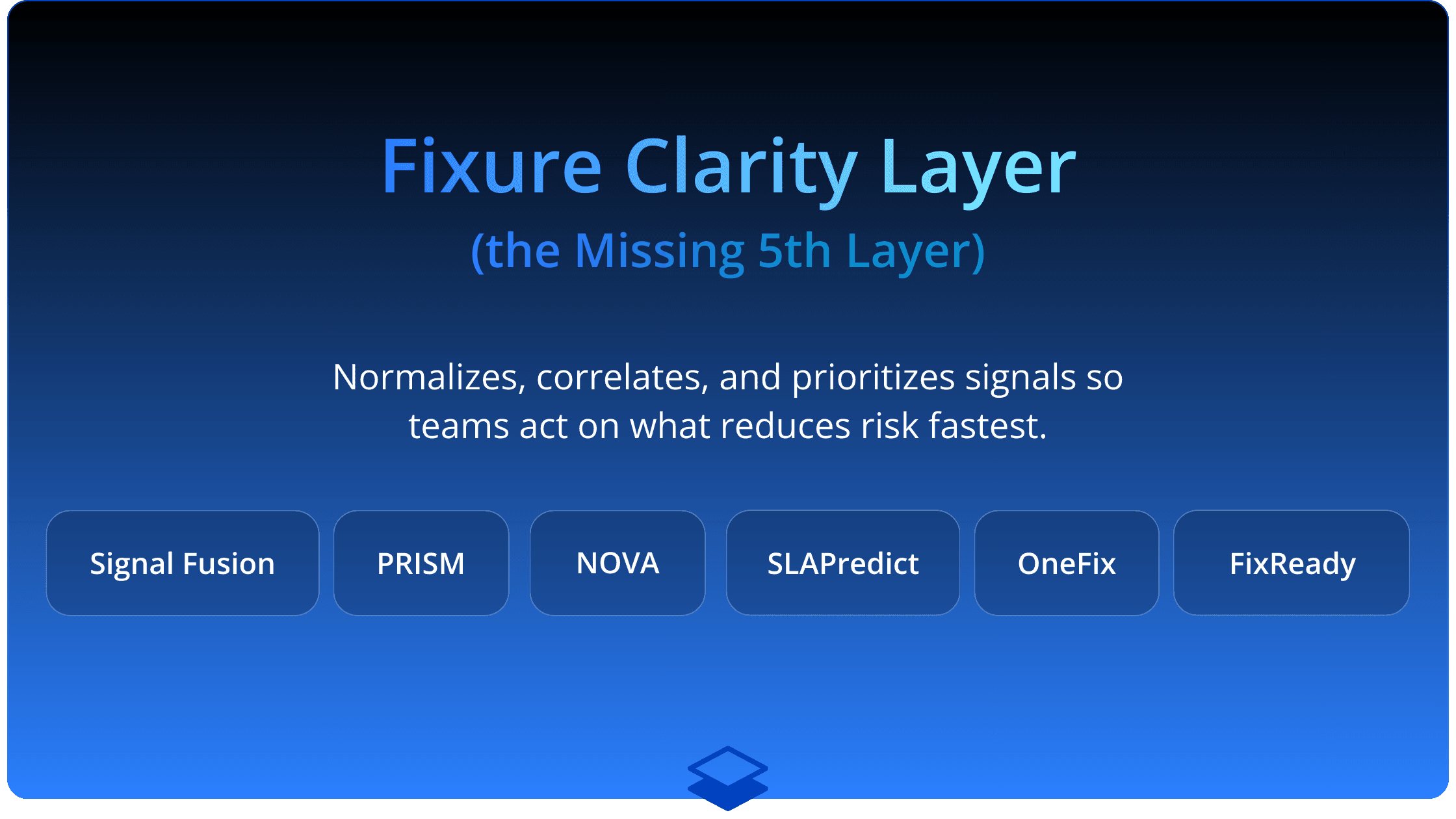
Fixure operates as the intelligence layer above detection. It resolves conflicts between security tools, collapses thousands of findings into root causes, and gives security teams a way to prioritize risk based on how their systems are actually built and exposed. The result is more consistent cybersecurity risk management—and a more practical approach to day-to-day cyber risk management—because decisions are grounded in real deployment context instead of isolated scanner output.
The Arbitration Problem
When three different security tools report the same vulnerability, they rarely use the same identifier. One references a CVE number. Another uses an internal tracking ID. A third cites the affected package version. Each assigns its own severity score based on what that particular tool understands about the risk.
An analyst has to figure out whether these are three separate issues, or one vulnerability reported three times. Then comes the more complicated question: which severity rating is correct? The code scanner says critical because it found a path to exploit. The cloud platform says medium because the service runs behind network restrictions. The dependency tracker says high because public exploits exist for this library version.
Someone needs to make a judgment call, and that gets harder when you're managing findings from a dozen tools and thousands of vulnerabilities.
Fixure handles arbitration systematically by recognizing when multiple tools describe the same vulnerability using different identifiers and consolidating them. When tools assign conflicting severity ratings, Fixure weighs them against deployment context: whether the vulnerability is reachable from the internet, what data it can access, and what other systems connect to it. An authentication bypass flagged as critical gets evaluated differently depending on whether it exists in a staging environment or in a production API that processes financial transactions. Cybersecurity risk assessment becomes about exposure in your infrastructure rather than theoretical severity scores.
This consolidation changes what developers receive. Instead of managing multiple contradictory tickets about the same vulnerability, they get one request with clear context about what's at risk and why it matters for their specific deployment. Security teams spend their time coordinating remediation instead of reconciling conflicting tool outputs.
Tracing Problems to Their Source
Consolidation addresses duplication, but security programs face another pattern. Many findings that appear distinct actually trace back to a common source. A single misconfigured CI/CD pipeline generates cascading problems. When it deploys fifty services, all fifty inherit the same configuration weaknesses. Security scanners detect vulnerable credentials in service A, overpermissive access in service B, and exposed endpoints in service C. Each finding gets its own ticket, and teams see multiple problems requiring separate investigations and fixes.
Fixure identifies this pattern by analyzing what the findings have in common. When dozens of vulnerabilities share the same configuration origin, deployment source, or dependency chain, the system traces them back to the point where they're created. Teams can fix the pipeline once instead of patching deployed services individually.
Organizations see their backlogs compress dramatically through this approach. The system also learns how long different types of fixes take based on past remediation work. If the data shows a team won't meet their SLA deadline at the current pace, they find out weeks ahead of time instead of after they've already missed it. This creates room to shift resources or adjust commitments before becoming a problem.
Every action in this process is automatically logged. When auditors need evidence of security decisions and remediation work, teams can pull complete records with timestamps and ownership information, rather than piecing together what happened from old tickets and messages.
Architecture Built for Intelligence
Security scanners operate within isolated domains and generate findings based on what they can see. Intelligence that connects these findings requires an architecture designed for correlation. Fixure operates as a control plane that builds a unified model of how code connects to deployments, how deployments connect to infrastructure, how infrastructure connects to data, and where exposure paths exist across the whole. Risk is evaluated based on relationships rather than treating every finding as independent—strengthening security posture management with decision-grade context instead of more dashboards.
Detection vendors face a structural problem when they try to provide this layer themselves. Their business depends on customers trusting their findings. When a cloud security platform must arbitrate between its own misconfiguration alert and a competitor's code vulnerability, consistently choosing the competitor's finding undermines the platform's value. Other vendors notice this bias and stop trusting the integration.
Fixure has no detection tool to protect. When weighing findings from Snyk, Wiz, and Veracode, the arbitration is based on deployment context and business impact rather than commercial interests. Our revenue comes from making existing tools more useful, not from generating more findings ourselves.
Owning the Decision Layer
At a certain scale, security stops being a tooling problem and becomes an ownership problem. Someone has to decide which signals matter, which ones collapse into the same issue, and where a fix changes risk.
Fixure is built for that role. It does the work that security teams already do by hand, across environments, and without bias toward any one vendor. For teams trying to operationalize cybersecurity risk management beyond severity scores, that decision layer is the missing link between detection and measurable reduction in cyber risk management.
If your program has outgrown dashboards and severity scores, it’s time to treat security decisions as a system. Request a demo and learn how Fixure implements Layer-5 in real environments.