Modern security stacks are built on powerful detection layers, but detection alone does not produce clarity. As environments scale, tools generate more signals than teams can reasonably interpret. The result is not lack of data, but lack of understanding.
This is where Layer-5 becomes necessary.
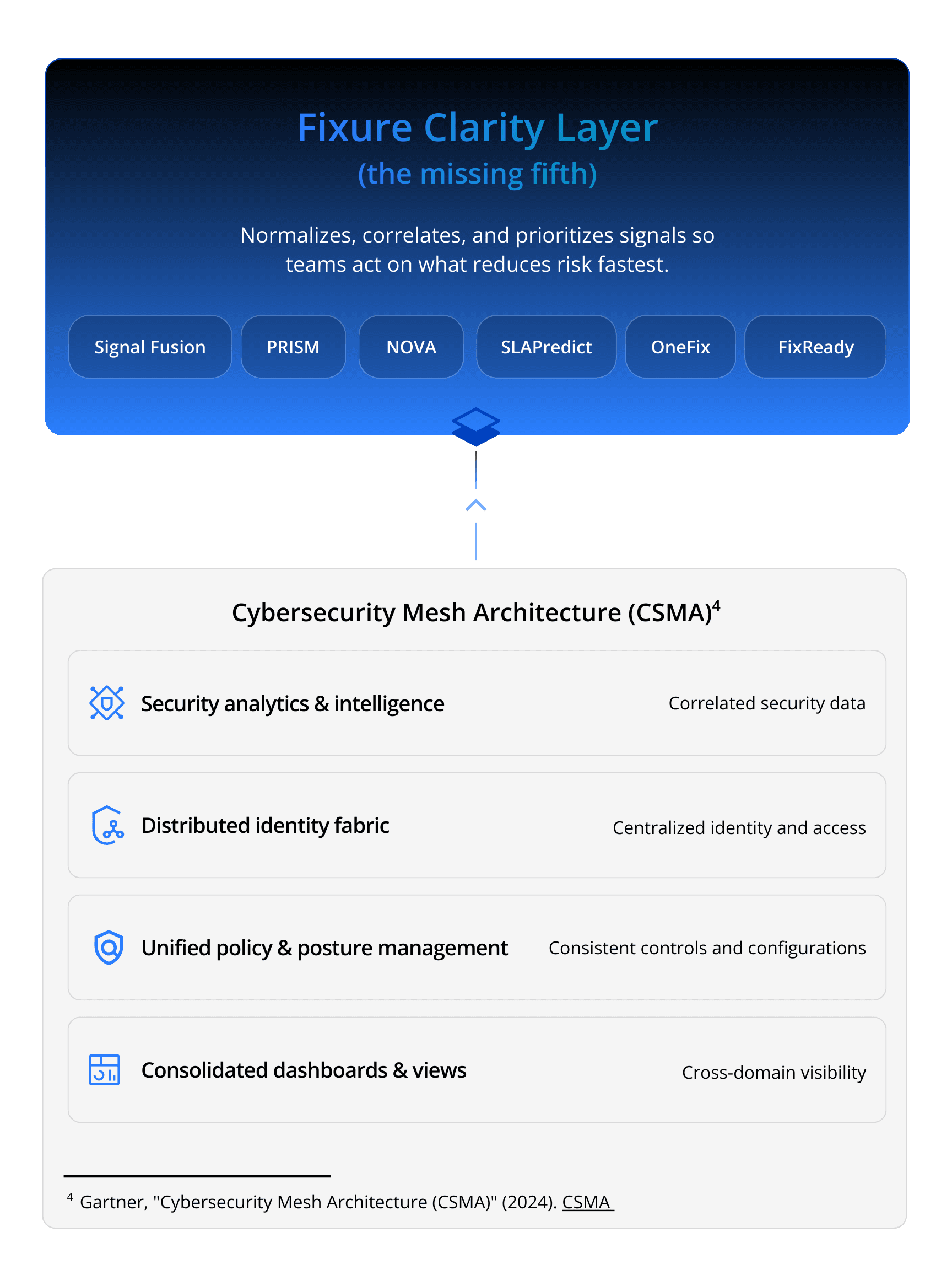
How the Security Stack Breaks Down
As shown in the model, modern security is built in layers.
The lower layers focus on detection. They scan code, cloud, infrastructure, identity, and runtime to surface issues within their domains. These layers are essential, but they operate independently. Each produces its own version of truth.
As signals accumulate, teams are left to reconcile overlapping findings, conflicting conclusions, and competing priorities. Decisions become subjective. Progress becomes difficult to explain. Effort increases without a clear sense of impact.
The stack has plenty of signal. What it lacks is a layer that can reason across it.
What Layer-5 Adds
Layer-5 sits above detection and aggregation to provide intelligence.
It connects signals across tools, understands how issues relate across systems, and reasons about impact and dependencies. Instead of asking teams to choose which tool to trust, Layer-5 establishes the context needed to decide what to do, in what order, and why.
This is not another detection category. It is the decision layer security has been missing.
From Signals to Decisions
- Without Layer-5, security teams manage findings.
- With Layer-5, they manage outcomes.
- Decisions are based on system context rather than tool output.
- Remediation focuses on root causes rather than individual issues.
- Progress is measured by reduced exposure, not activity volume.
- Layer-5 represents the shift from signal management to security decision intelligence.
Why Fixure?
Fixure is the first platform built from the ground up to operate at Layer-5.
It does not replace your tools. It sits above them, bringing reasoning, context, and clarity to the decisions your security program depends on.